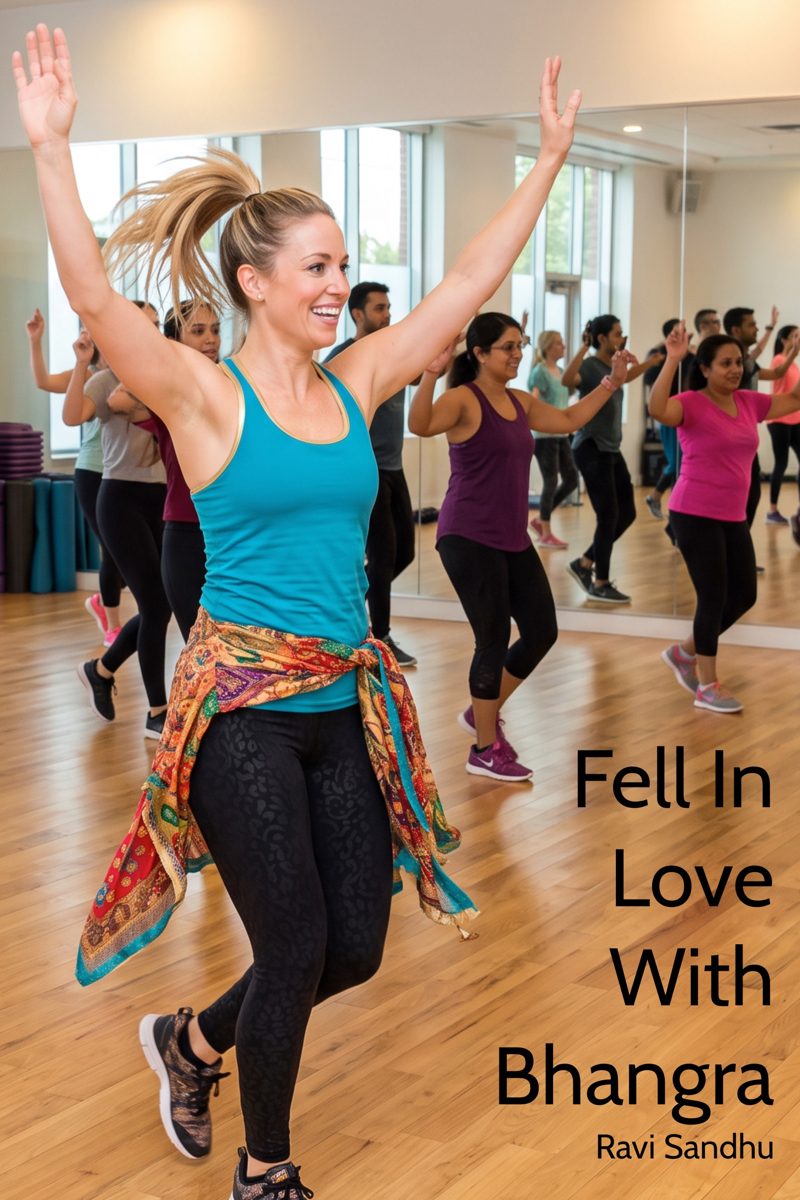
Fell In Love With Bhangra
A note before we begin
This story starts with something real: a clip of Diljit Dosanjh performing "Morni" on The Tonight Show, the kind of video the algorithm hands you at midnight and doesn't let go of. Everything that happens after Sam watches that clip — every person she meets, every class she takes, every mistake and correction along the way — is invented. Diljit Dosanjh and Jimmy Fallon appear only as the real, public moment that exists in the world; they are not characters in this book and never speak a line in it.
Sam's fitness path runs through Pungra, our fictional organisation that specialises in group exercise to Punjabi music, along with its four-storefronts framework, its CEAT teaching method, and its certification pathway — all consistent with the Pungra universe already built. Founder Ravi Sandhu is referenced as an off-page, legendary-in-the-community figure, the way any founder of a standards body might be discussed by the people who follow that standard.
One more thing worth knowing before you start, because it's really what this whole book is about underneath the dancing.
In 1955, two psychologists named Joseph Luft and Harrington Ingham built a simple model of self-awareness — they called it the Johari Window, combining their first names, Joe and Harry. It splits everything knowable about a person into four panes: what's known to you and known to others; what you keep hidden, known to you but not to others; what's unknown to everyone, not yet discovered by anyone at all; and one pane that matters more than the rest for a story like this one — the blind spot, the things other people can see about you clearly that you yourself cannot see at all.
Here's a strange, true thing about actual human eyes, not just the psychological metaphor. Each of your eyes has a real blind spot — a small patch of the retina, where the optic nerve exits toward the brain, that has no light-sensing cells at all. There's a hole in your vision, right now, in both eyes, and you have never once seen it, because your brain quietly fills the gap using whatever pattern surrounds it, stitching together a seamless picture out of information that was never actually there. You've been trusting a picture your brain partly invented, every waking second of your life, and it has never once felt like anything other than simply seeing.
It doesn't stop at the eyes. Your brain and your senses would drown if they gave equal attention to every stimulus reaching them — every sound, every face, every detail of every room you've ever walked into. So they don't. They watch for pattern, and they watch for threat, and if something registers as neither new nor dangerous, it gets quietly tuned out, filed away as already understood, whether or not it was ever actually examined at all. This is efficient. It's also how an entire culture, an entire industry, an entire person, can go years — decades — being looked at without ever really being seen.
This book is about exactly that kind of blind spot — the ones a mind builds not out of malice but out of simple economy, the details it stopped examining long ago because nothing about them ever seemed urgent enough to check. It's about what happens when somebody, almost by accident, gets curious enough to go back and look directly at the gap anyway, and finds that the picture their brain had been quietly filling in wasn't quite the whole truth after all.
One last thought, and then we'll get out of the way and let the story do the work. Every tradition, every industry, every person, eventually faces the same quiet choice: keep the picture exactly as it's always been, or look at the gap and let it become something new. This book has a soft spot for the second kind of person — the ones who notice a room could hold one more thing than anybody's tried putting in it yet, and go ahead and try anyway, rather than the ones who'd rather defend the room exactly as they found it. If you've ever been the person suggesting the new idea in the room rather than the one waiting to see if it catches on first, Sam's story was written with you specifically in mind.
Principal characters
- Sam (Samantha) Whitfield, 38 — our protagonist. Marketing manager at MedGen Health in Swindon, England. Part-time spin and Zumba instructor at Ascent Fitness on weekends. Divorced two years from Dave. Mother to Maya. Was a competitive dance team member at university before life folded that identity away.
- Maya Whitfield, 15 — Sam's daughter. Sharp, online-fluent, initially mortified by her mother's new obsession, then her most devoted co-conspirator.
- Dave Whitfield, 41 — Sam's ex-husband. Not a villain — an amicable co-parent slightly thrown by how much his ex-wife is changing.
- Rachel Ostrowski, 39 — Sam's best friend since their kids were in preschool together. Works in real estate. Loving, a little skeptical of Sam's "phases," becomes a true believer.
- Amrit Deol, 43 — Pungra-certified instructor running classes out of a studio in Birmingham. Sam's mentor. Precise, warm, allergic to nonsense, deeply serious about the standard she holds.
- Harpreet Bains, 61 — a longtime student in Amrit's classes, originally from Jalandhar, now retired and living in Birmingham. Becomes an unlikely, delightful friend to Sam and the person who talks her down from quitting.
- Josh Alvarez, 34 — another non-Punjabi regular in Amrit's class, a few months ahead of Sam on the same road, occasional comic relief and proof Sam isn't the only one figuring this out in public.
- Priya Deol, 17 — Amrit's daughter, becomes an easy, unforced friend to Maya.
- Carol Whitfield, 66 — Sam's mother, skeptical at first ("Another one of your things, Sam?"), eventually won over.
Find this book on
 Spotify link coming soon
 Apple Books link coming soon
 Google Books link coming soon